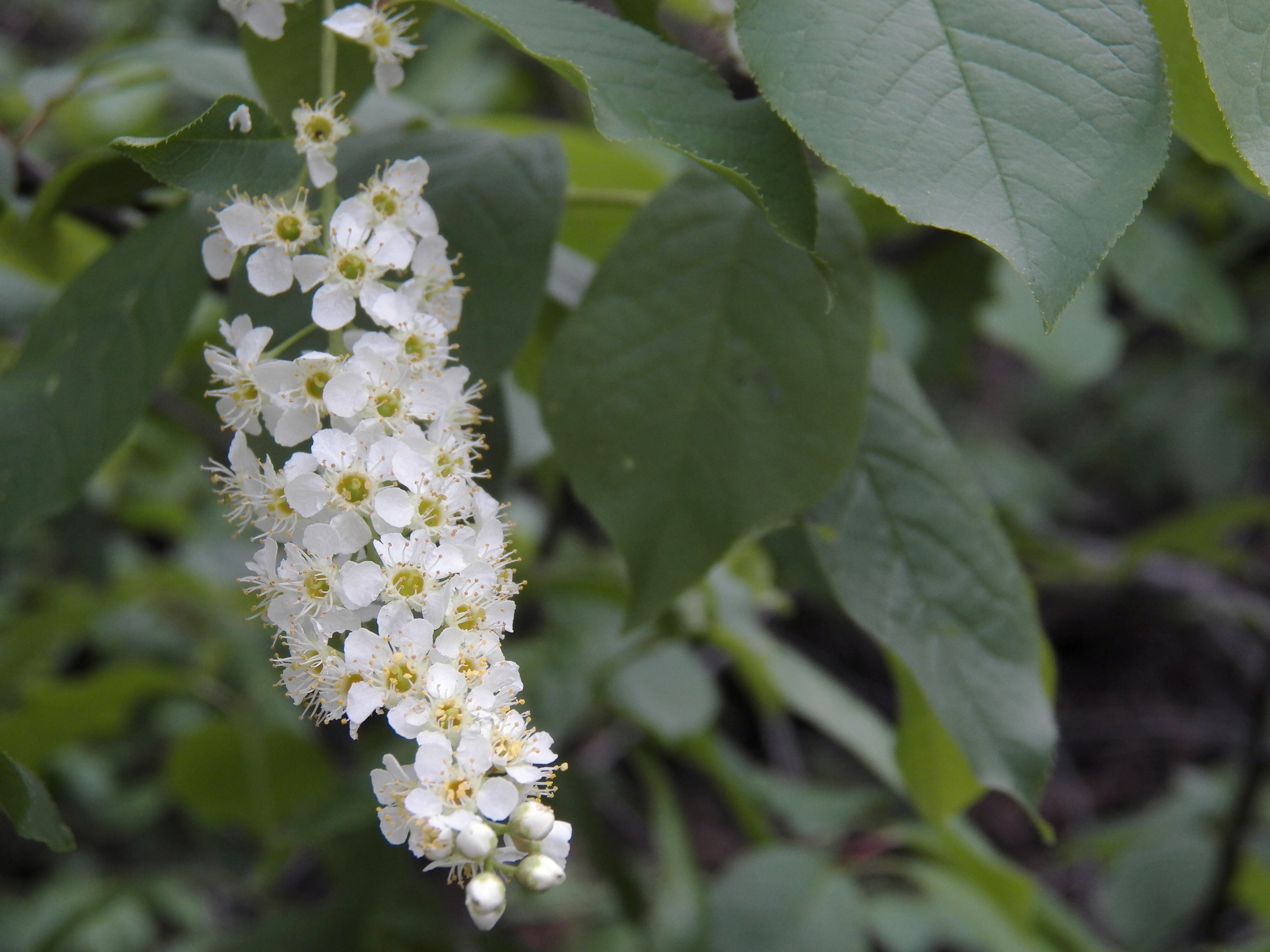
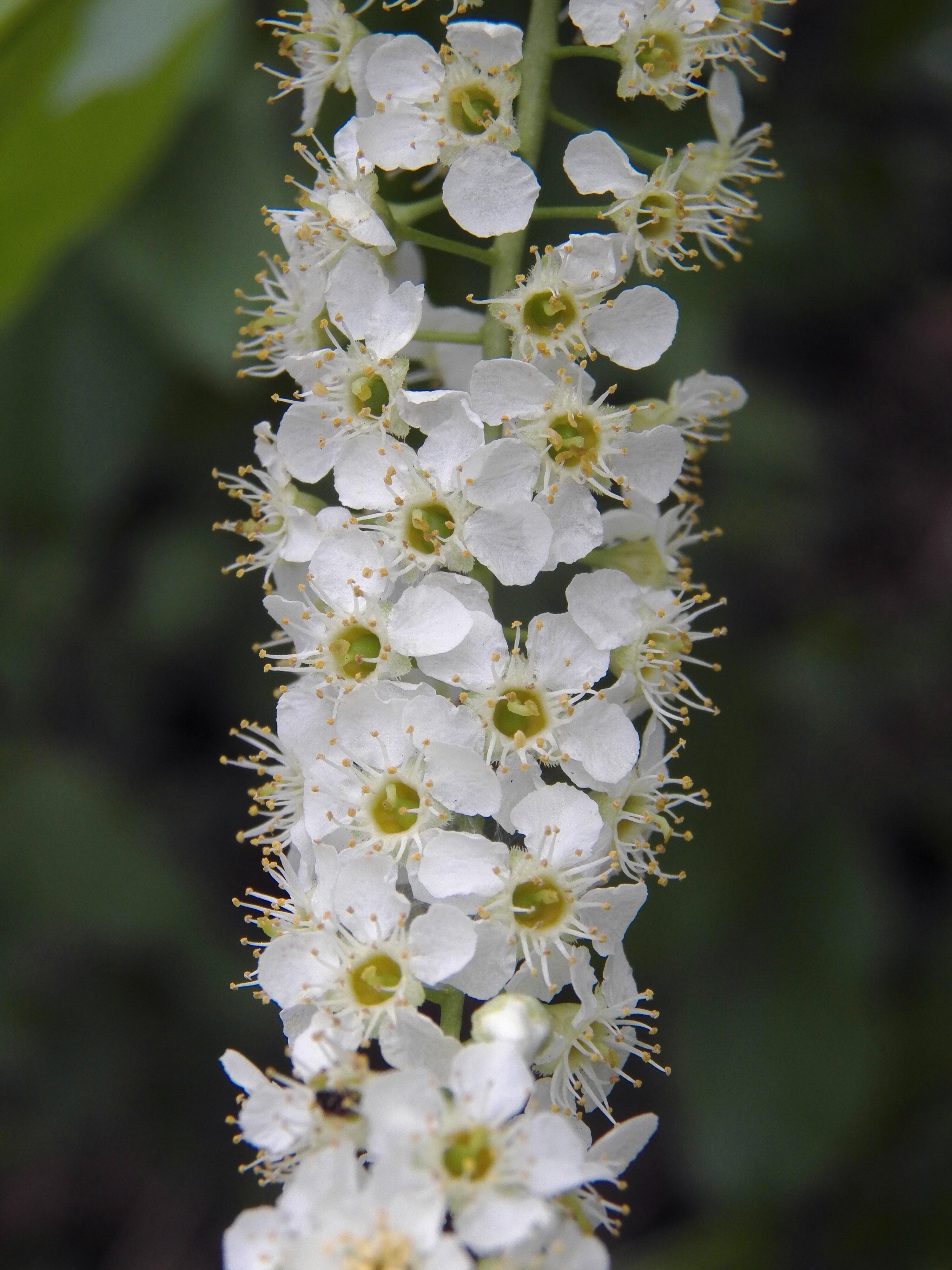
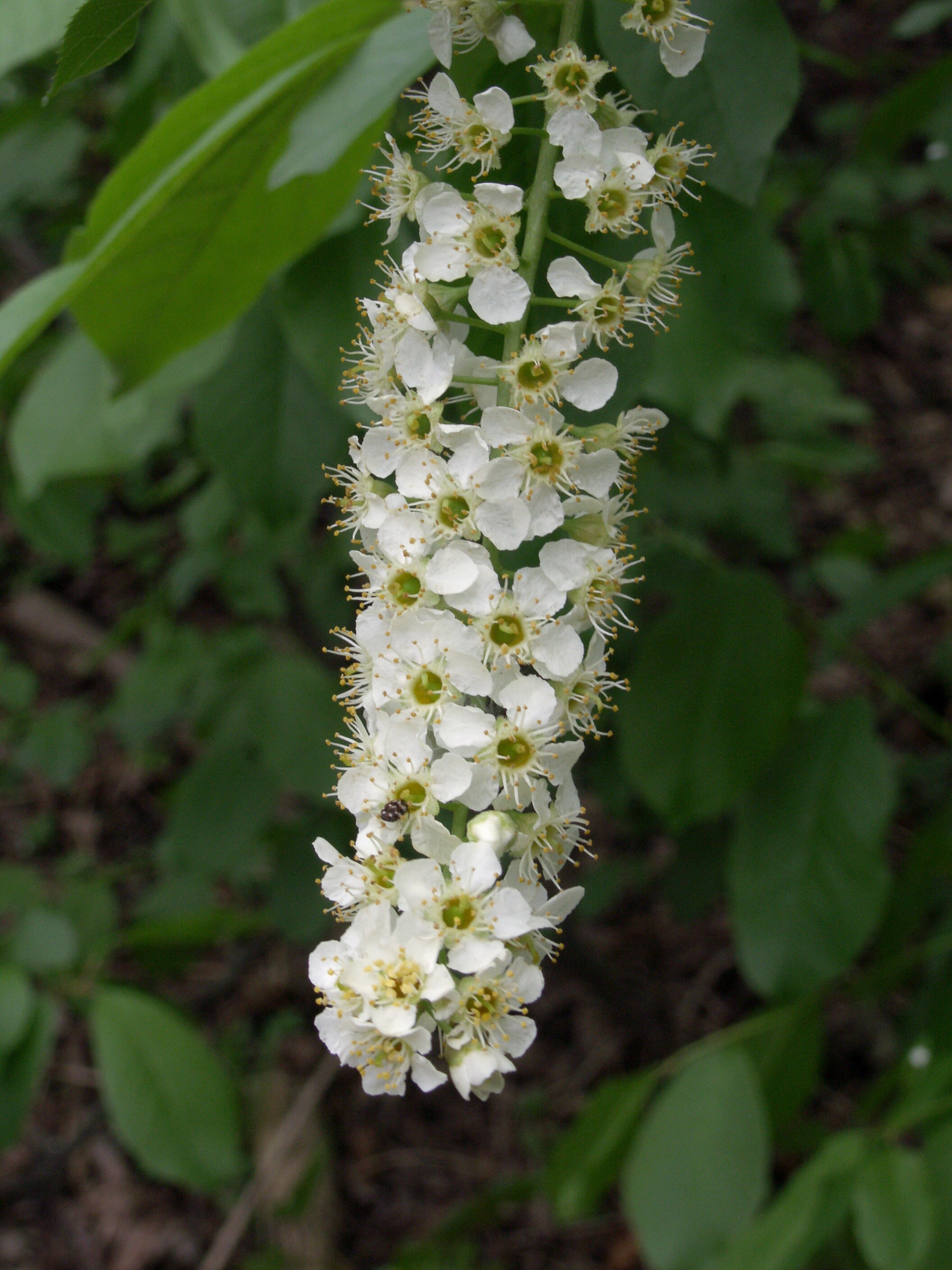
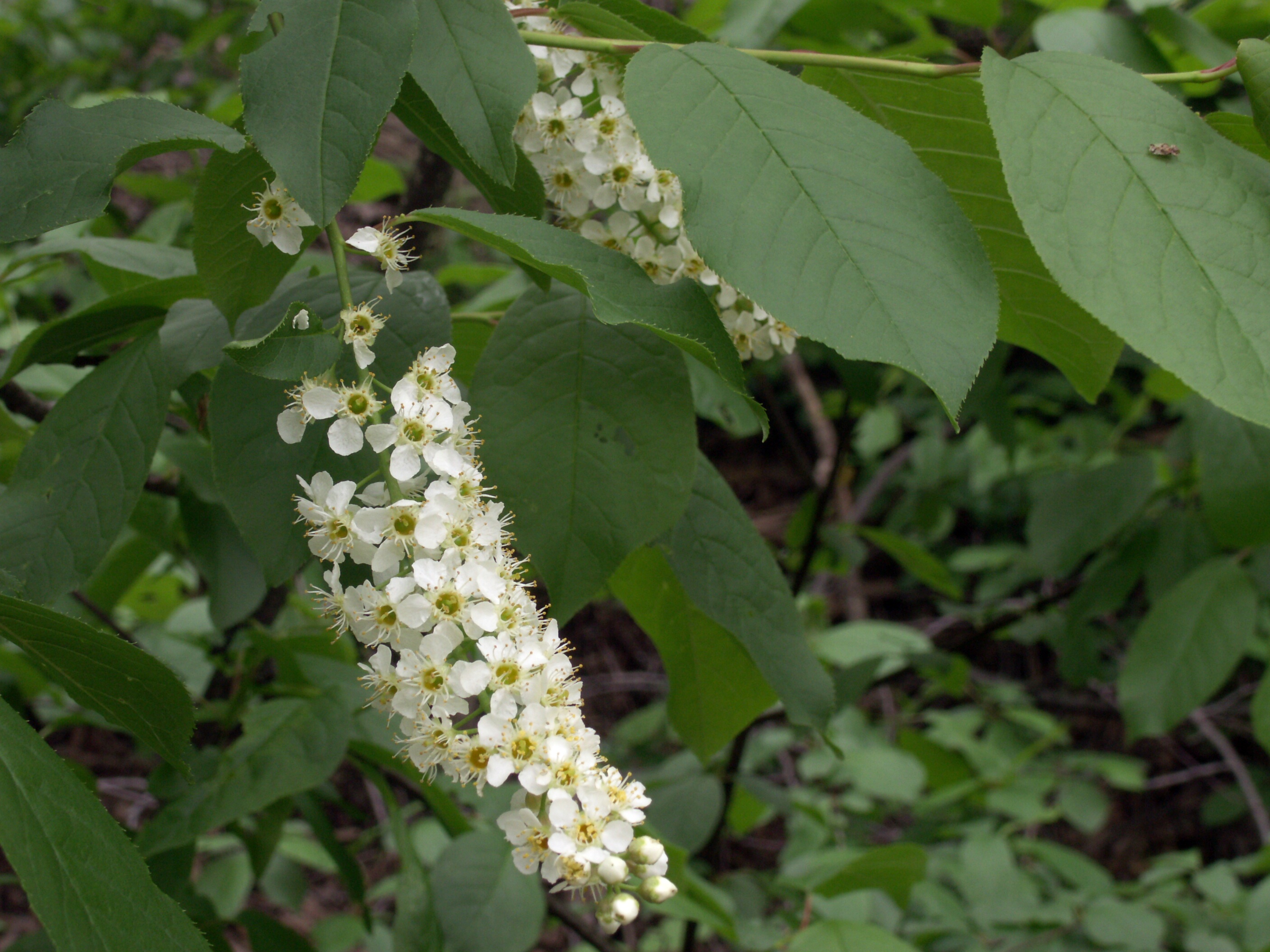
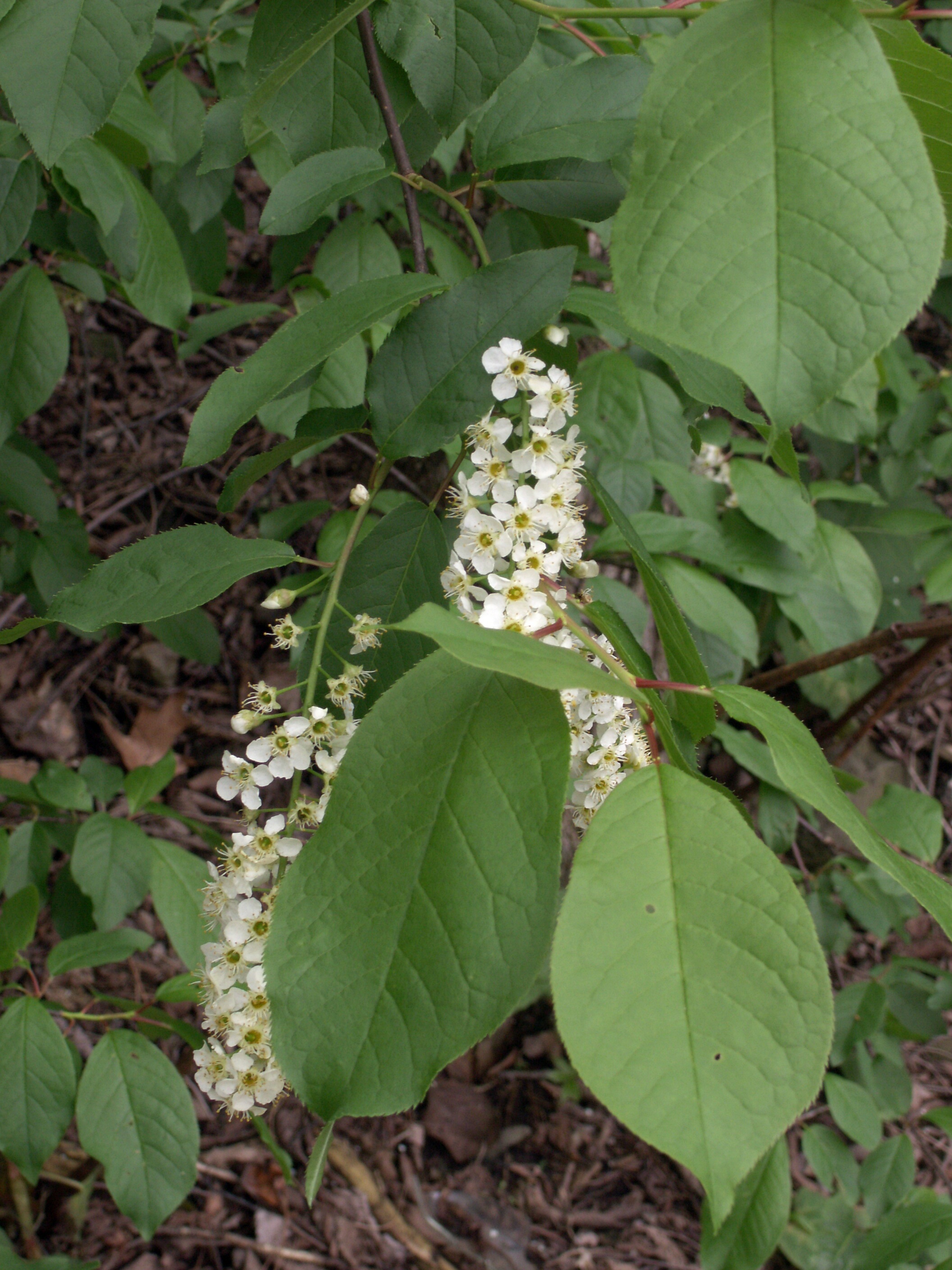
Racemes of little white flowers cover the trees in the spring, followed by tiny but delicious black cherries. Similar to the Choke Cherry (Prunus virginiana), but with narrower, glossier leaves; and the Black Cherry grows into a large tree with ragged bark, whereas the Choke Cherry seldom exceeds a large shrub and has smooth bark. This tree was growing in Bird Park, Mount Lebanon.
Our identification is probable, but it is hard to tell the difference between a Choke Cherry and a young Black Cherry (Prunus serotina). Black Cherries grow into substantial trees with ragged bark; this plant was a shrub with rather smooth bark. The leaves were also less glossy than we expect from a Black Cherry. The plant was blooming near the Saw Mill Run Boulevard end of the Seldom Seen Greenway.
Wikipedia’s article on Pyrus calleryana will explain to you why you should not call the wild trees “Bradford Pear,” and you may choose to be pedantically correct if you like. “Bradford” was a popular cultivar of Callery Pear widely planted in the United States as an ornamental tree; the trees that have spring up on their own in our forests over the past thirty years or so have mixed cultivars in their ancestry. However, “Bradford Pear” has become the common name of the species, whatever the botanists say, and we must use it to be understood. “Melius est reprehendant nos grammatici quam non intelligant populi,” as St. Augustine said: better the grammarians should chide us than the people not understand us.
It was not common to see these trees in the wild thirty years ago, but now they light up the woods all over Pittsburgh and its suburbs in the early spring. They have become such a common escape that Pennsylvania recently banned the sale of Pyrus calleryana on the grounds that it is a noxious weed. But the trees are beautiful, and they are nowhere near as noxious as the Japanese monster knotweeds, so we should not feel guilty about enjoying them when they are one of the first trees to bloom in the spring. This tree was growing in Bird Park, Mount Lebanon.
The pale cream flowers are distinctive, although occasional deep yellow variants occur. This is the largest-flowered cinquefoil that commonly grows wild in our area. It came from Europe and has established itself in vacant lots, unmown fields, and other places where humans have altered the landscape. These plants were blooming in a vacant lot in Beechview.
The leaves have five or seven parts, almost but not completely divided at the center.