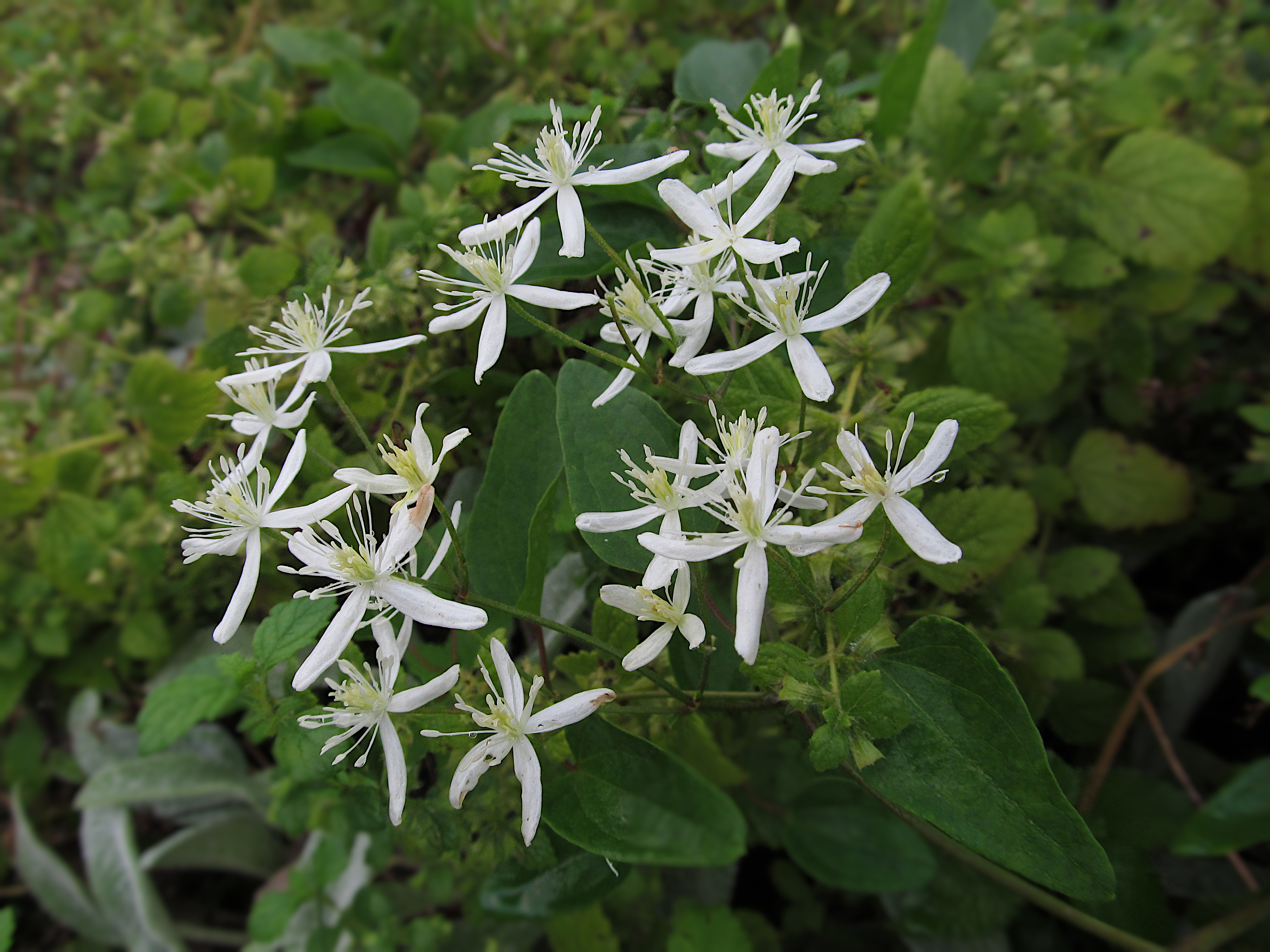
A garden ornamental that has made its escape into the wild, this vine has not yet become an invasive pest here, but is fairly common now in vacant lots and other unexpected places in the city. It covers itself with little white flowers (usually four-parted, but with a fair number of five-parted variants) in late summer, with occasional blooming branches up to frost. These plants were growing wild on a bank in Beechview, where they were blooming in early September.
Even the usual plain white flowers are very attractive. The rarer bicolor forms like this are beautiful—and almost poetic when we add raindrops. The plant may be a pernicious weed, but we should appreciate the beauty even of our pernicious weeds.
We have seen Calystegia sepium before, and we repeat the text of the previous article:
Also called Wild Morning Glory. Hedge Bindweeds do indeed love hedges, but they really come into their own on a chain-link fence. Most often the flowers are white, but sometimes we see a glorious bicolor like this one, which in size and color rivals the cultivated Morning Glory.
Gray makes Calystegia a division of the genus Convolvulus. He describes the genus, division, and species:
CONVOLVULUS [Tourn.] L. BINDWEED Corolla funnel-form to campanulate. Stamens included. Capsule globose, 2-celled, or imperfectly 4-celled by spurious partitions between the 2 seeds, or by abortion 1-celled, mostly 2-4-valved. Herbs or somewhat shrubby plants, twining, erect, or prostrate. (Name from convolvere, to entwine.)
CALYSTEGIA (R. Br.) Gray. Stigmas oval to oblong; calyx inclosed in 2 broad leafy bracts.
C. sepium L. (HEDGE B.) Glabrous or essentially so; stem high-twining or sometimes trailing extensively; leaves triangular-halberd-shaped, acute or pointed, the basal lobes obliquely truncate and often somewhat toothed or sinuate-lobed or merely rounded ; peduncles chiefly elongated, 4-angled; bracts rounded to sharp-acuminate at tip ; corolla white or rose-color, 3-5 cm. long. (Including var. americanus Sims.) Moist alluvial soil or along streams. June-Sept. (Eurasia.)
These showy vines have appeared here more than once, and doubtless they will appear again. They have a magnetic attraction for the camera. All these pictures, by the way, went straight from the camera to publication without any alteration, because Morning Glories can’t help making good pictures.
In previous articles, we gave this description, which we repeat here:
Flowers. Large and showy; trumpet-shaped, like an old phonograph horn; five-parted, with white center and contrasting darker markings radiating from the center. They come in several colors, from the deepest velvety purple to bright pink. They close by midday, or later if the weather is chilly or dark.
Leaves. Heart-shaped, or on vigorous and high-growing vines sometimes three-lobed, like a grape leaf; smooth above, lightly rough-hairy below; strongly veined.
Stem. Hairy; bright green; long and climbing; climbs by wrapping itself around any support, often bundling with other stems from the same plant, forming a dense mound; can climb to 9 feet (3 m) or so in one season.
Gray describes the genus and the species, which he places in the Euipomoea or Ipomoea-proper section of the genus:
IPOMOÈA L. MORNING GLORY. Calyx not bracteate at base, but the outer sepals commonly larger. Corolla salver-form or funnel-form to nearly campanulate; the limb entire or slightly lobed. Capsule globular, 4-6 (by abortion fewer)-seeded, 2-4-valved. (Nаmе, according to Linnaeus, from ips, a Bindweed, and homoios,like; but ips is a worm.)
§ 2. EUIPOMOÈA Gray. Corolla funnel-form or nearly campanulate, contorted in the bud; stamens and style not exserted
Lobes of stigma and cells 3, sepals long and narrow, attenuate upward, mostly hirsute below; corolla purple, blue, or white. (MORNING GLORY.)
I. purpurea (L.) Roth. (COMMON M.) Annual; stems retrorsely hairy; leaves heart-shaped, acuminate, entire; peduncles long, umbellately 3-5-flowered; calyx bristly-hairy below; corolla funnel-form, 4.5-7 cm. long, purple, varying to white. — Escaped in cultivated grounds. (Introd. from Trop. Am.)
It is no secret that the ironweeds are among Father Pitt’s favorite flowers. When we take a close look at the flowers, we can see that the impression of extraordinarily vivid purple is partly created by adding some bright orange and white.
This beautiful plant has appeared here more than once, but here we have some fine deep pink Phlox from the Seldom Seen Greenway, where they were growing next to Saw Mill Run.
We repeat what we have said before about Phlox paniculata:
Pittsburgh is in the native range of Phlox paniculata, but the flower is so popular in gardens, and persists and spreads for so many years after planting, that we always have to suspect any individual plant of being a garden escape. It is often found near old homesites (as it was here in Seldom Seen, where the trail along Saw Mill Run was the main street of a little village until sixty years ago).
Phlox is so much beloved in Pittsburgh that any plant with a vaguely similar inflorescence is likely to be called “Phlox,” Dame’s Rocket (Hesperis matronalis) and Soapwort (Saponaria officinalis) being two notable examples. This, however, is the real thing.
The flowers come in a range of colors from white through pink to purple. In the Pittsburgh area at least, the species shows a remarkable affinity for the edges of old cemeteries, where perhaps it was once a popular planting.