Author: Father Pitt

  • Coltsfoot (Tussilago farfara)

    KONICA MINOLTA DIGITAL CAMERA
    KONICA MINOLTA DIGITAL CAMERA

    Like most other spring flowers, the Coltsfoots are quite late this year; this clump was blooming along a wooded trail in Scott Township in the middle of April.

    More pictures of this species are here and here.

    Gray describes the genus and the species:

    TUSSILÀGO [Tourn.] L. COLTSFOOT. Head many-flowered; ray-flowers in several rows, narrowly ligulate, pistillate, fertile; disk-flowers with undivided style, sterile. Involucre nearly simple. Receptacle flat. Achenes slender-cylindric or prismatic; pappus copious, soft, and capillary. — Low perennial, with horizontal creeping rootstocks, sending up scaly scapes in early spring, bearing a single head, and producing rounded heart-shaped angled or toothed leaves later in the season, woolly when young. Flowers yellow. (Name from tussis, a cough, for which the plant is a reputed remedy.)

    T. farfara L. — Wet places and along brooks, e. Que. to Pa., O., and Minn. (Nat. from Eu.)

  • Porcelain Berry (Ampelopsis brevipedunculata)

    OLYMPUS DIGITAL CAMERA

    Parthenocissus-tricuspidata-2013-10-17-Oakland-01[Update: We had originally identified this as Boston Ivy, but a kind correspondent pointed out the error.]

    An Asian vine now considered an invasive species in our area, especially in the city. The National Park Service gives us this description:

    Plant: deciduous, woody, perennial vine that resembles grape and climbs by non-adhesive tendrils at the base of each leaf; grows to 15-20 ft.; young twigs are usually pubescent; stem pith is white (grape is tan or brown) and is continuous across the nodes (except for V. rotundifolia, grape is interrupted by a diaphragm across the node); bark is dotted with lenticels and does not peel (grape bark lacks lenticels and peels or shreds).

    Leaves: alternate, simple, 3-5 lobed to highly dissected with heart-shaped base and coarsely toothed margins, shiny underneath with hairs on veins.

    Flowers, fruits and seeds: tiny, greenish-white flowers with petals separate at their tips occur in flat-topped clusters opposite the leaves; appear in summer (June through August); fruit is a speckled berry in colors ranging from aqua to pink to purple; each berry carries 2-4 seeds.

    Spreads: by seed that is eaten by birds and other small animals and dispersed in their droppings.

    Look-alikes: native species of grape (Vitis) and peppervine (Ampelopsis) including heartleaf peppervine (Ampelopsis cordata) which is native to the Southeast and has unlobed leaves and smooth (hairless) stems; other native Ampelopsis have compound leaves.

    These vines sprawled over a chain-link fence in the back streets of Oakland, where they were blooming and fruiting in the middle of October.

  • Purslane (Portulaca oleracea)

    OLYMPUS DIGITAL CAMERA

    This tiny prostrate weed is a close relative of the colorful Moss Roses we grow in gardens—the thick, fleshy red stems and succulent leaves show the relationship clearly. The little yellow flowers open only in the morning, and only in bright sunlight; we shaded the plants momentarily to take these pictures at midday without the harsh glare. Purslanes can grow almost anywhere they get a foothold, and can survive being pulled up and thrown away to root elsewhere. In the city they are very common crack-in-the-sidewalk weeds. The plant above was growing from a crack on the top of a low concrete wall; the one below (magnified many times—the boulders in the picture are ordinary gravel) was growing in a gravel parking lot. Both were a little west of Cranberry, blooming in early September. Purslane was once commonly used as a salad green, valued for its texture rather than its famously bland taste.

    OLYMPUS DIGITAL CAMERA

    We are experimenting with a camera we bought used for $20 that claims to be able to focus as close as an inch from the subject. So far, we are pleased with the results.

    Gray describes the genus and the species:

    PORTULACA [Tourn.] L.  PURSLANE. Calyx 2-cleft; the tube cohering with the ovary below. Petals 5, rarely 6, inserted on the calyx with the 7-20 stamens, fugacious. Style mostly 3-8-parted. Pod 1-celled, globular, many-seeded, opening transversely, the upper part (with the upper part of the calyx) separating as a lid. — Fleshy annuals, with mostly scattered leaves. (An old Latin name, of unknown meaning.)

    P. olerácea L. (COMMON P.) Prostrate, very smooth; leaves obovate or wedge-form ; flowers sessile (opening only in sunny mornings); sepals keeled; petals pale yellow; stamens 7-12 ; style deeply 5-6-parted; flower-bud flat and acute. — Cultivated and waste grounds; common.—Seemingly indigenous westw. and southwestw. (Nat. from Eu.)

  • Orange Hawkweed (Hieracium aurantiacum)

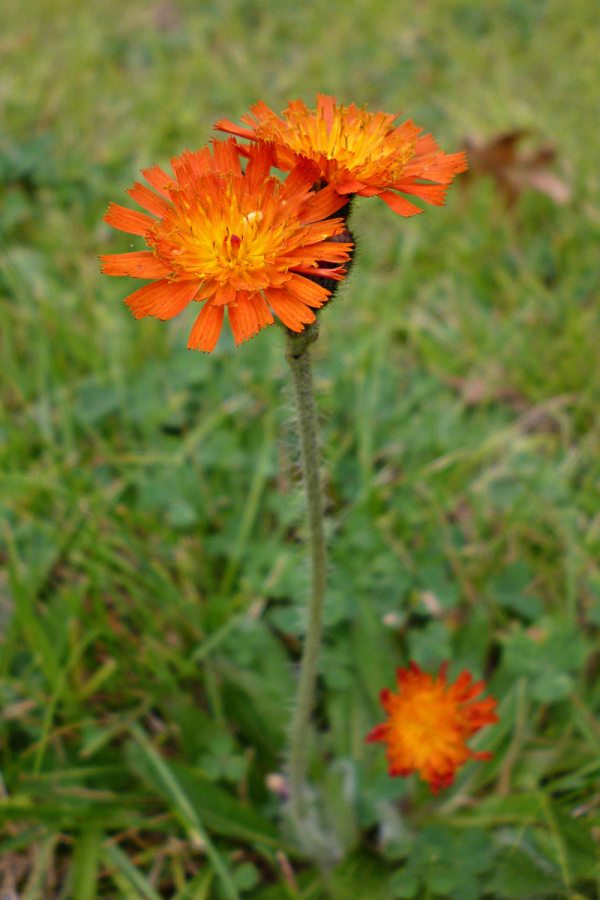
    Hieracium-aurantiacum-2013-09-02-Fox-Chapel-02Until today we had not found this plant in the city of Pittsburgh, though it is ubiquitous north of a line that roughly bisects Pennsylvania from east to west. This plant, however, was one of a number growing in a lawn in Highland Park, where it was blooming at the beginning of September.

    There is no mistaking this plant for anything else. There are many flowers that look like small dandelions, but only one is bright orange—a rare color among flowers, otherwise represented here mostly by Daylilies and Orange Touch-Me-Nots.

    We had previously collected a picture of this species from Crawford County, and we repeat our remarks:

    Also called “Devil’s Paintbrush,” on the principle that attributes anything striking or bright in nature to satanic forces. Gray gives another name, Grim the Collier, that refers to a traditional character who gets the best of the devil in folk tales, putting our subject on the side of good rather than evil.

    This would be an ordinary dandelion-like weed, except that the flowers are bright orange, making it one of our showiest wild flowers. It seldom or never [obviously this is not true] comes as far south as the city of Pittsburgh itself, but begins to be seen in the northern fringes of our area, and becomes quite common farther north in Pennsylvania.

    This species is often placed in the genus Pilosella, but there seems to be much uncertainty. The imperfectly omniscient Wikipedia leads us on a merry chase: Hieracium aurantiacum redirects to Pilosella aurantiaca, but Pilosella redirects to Hieracium. [This is still true three years later.]

    Gray describes the genus and the species:

    HIERACIUM [Tourn.] L. HAWKWEED
    Heads 12-many-flowered. Involucre more or less imbricated. Achenes short, oblong or columnar, striate, not beaked; pappus a single row of tawny and fragile capillary rough bristles. —Hispid or hirsute and often glandular perennials, with entire or toothed leaves, and single or panicled heads of mostly yellow flowers; summer and early autumn. (Name from hierax, a hawk.)

    * Flowers orange-red.

    H. aurantiacum L. (ORANGE H., DEVIL’S PAINT-BRUSH, GRIM THE COLLIER.) Long-hirsute; leaves oblanceolate, 6-15 cm. long, green on both sides; a stolons numerous, slender; scape 2-6 dm. high, usually 1-2-bracted; heads about 2 cm. broad. Fields, etc., e. Que. to Ont. and Pa., locally too abundant. June, July. (Nat. from Eu.)
  • Blue Vervain (Verbena hastata)

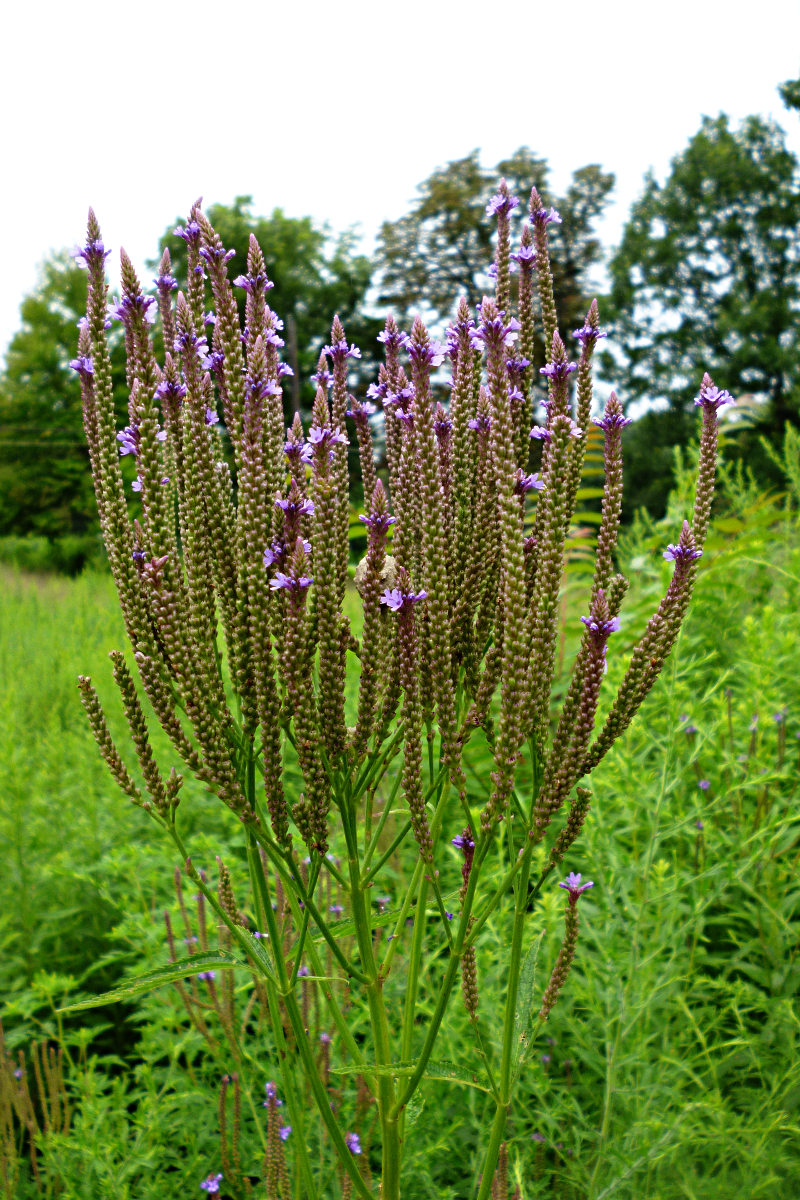
    Verbena-hastata-2013-08-14-Schenley-Park-01The tiny flowers of this cheerful plant make a fine display—not too ostentatious, but elegant and striking. This one was growing in a field in Schenley Park, where it was blooming in the middle of August.

    More pictures of this species are here, where you will also find quite a bit of lore taken from old books.

    Gray describes the genus and the species:

    VERBENA [Tourn.] L. VERVAIN. Calyx 5-toothed, one of the teeth often shorter than the others. Corolla tubular, often curved, salver-form; the border somewhat unequally 5-cleft. Stamens included, the upper pair occasionally without anthers. Style slender; stigma mostly 2-lobed. — Flowers sessile, in single or often panicled spikes, bracted, produced all summer. (The Latin name for any sacred herb; derivation obscure.) — The species present numerous spontaneous hybrids.

    § 1. Anthers not appendaged; flowers small, in slender spikes.

    Spikes thicker or densely flowered; the fruits crowded, mostly overlapping one another; bracts inconspicuous, not exceeding the flowers; perennial.

    V. hastàta L. (blue V.) Tall (0.5-2 m. high); leaves lanceolate or oblong-lanceolate, taper-pointed, cut-serrate, petioled, the lower often lobed and sometimes halberd-shaped at base; spikes linear, erect,corymbed or panicled; flowers violet-blue (rarely pink or white). —Damp grounds, etc.