Category: Asteraceae

  • Canada Goldenrod (Solidago canadensis)

    2009-09-25-Solidago-canadensis-01

    It’s so common that we hardly see it, but Canada Goldenod is a breathtakingly spectacular flower, much appreciated in European gardens. Americans often unjustly blame it for hay fever, when in fact it is the nearly invisible ragweeds, with their unremarkable green flowers that bloom alongside the goldenrods, that are the culprits. Here a Canada Goldenrod grows from a crack in the pavement beside a vacant building in Oakmont, where goldenrods, asters, thoroughworts, and evening primroses have formed a more artistic border than any human gardener could have conceived.

    Goldenrods are notoriously difficult to sort out, with dozens of species fading into one another. Our identification is probable but not certain.

    From Gray’s Manual of Botany: S. canadensis L. Stem rather slender, 0.3-1.5 m. high, glabrous at least below, often minutely pubescent above; leaves narrowly lanceolate, thin, glabrous above, minutely pubescent on the nerves beneath, mostly sharp-serrate, the middle ones 6-13 cm. long, 5-18 mm. wide; heads tiny, crowded in recurved racemes and forming dense broadly pyramidal panicles; pedicels strongly pilose; involucral bracts linear, mostly attenuate, greenish-straw-color. (Var. glabrata Porter.) Thickets and rich open soil, Nfd. to N. Dak., s. to W. Va. and Ky. July-Sept.

  • Panicled Aster (Aster paniculatus)

    2009-09-25-Aster-paniculatus-01

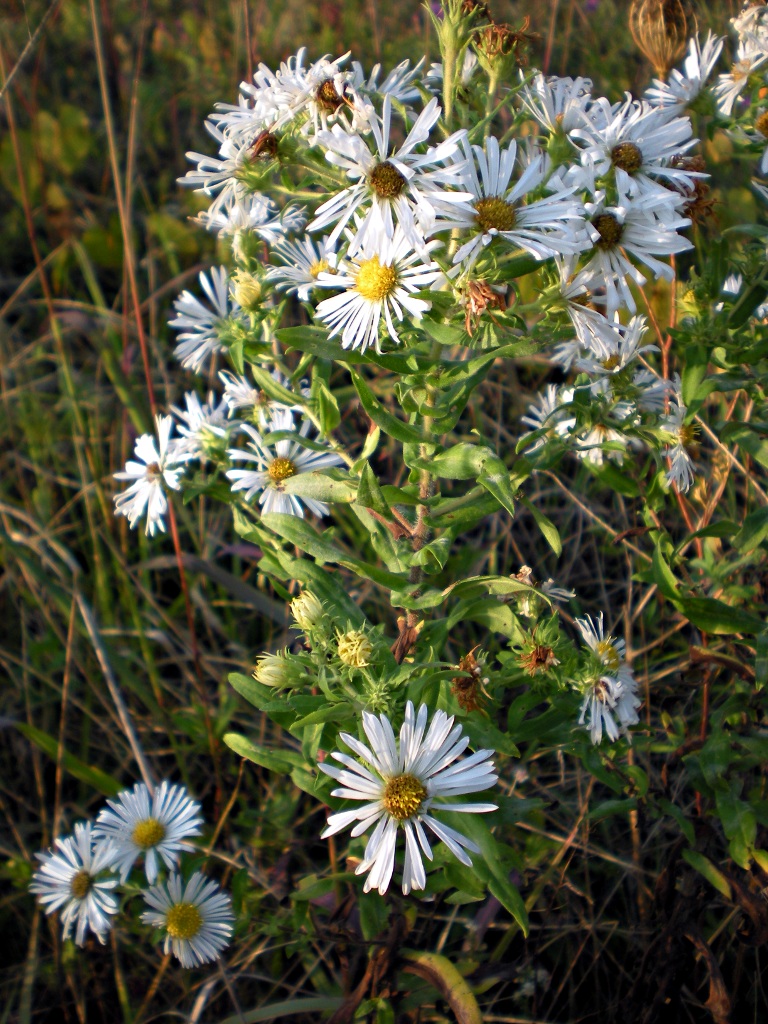
    Also known as Tall White Aster. A spectacularly beautiful plant, growing to eight feet and covered with starry white flowers. These plants grew along a corrugated steel fence near a railroad track in Oakmont.

    From Gray’s Manual of Botany: A. paniculatus Lain. Stem smoothish, 0.5-2. 5m. high, much branched; the branches and scattered heads (about 2 cm. broad) loosely paniculate; leaves elongate-oblong to narrowly lanceolate, pointed, somewhat serrate or entire; the cauline 0.5-1.5 dm. long, about 1 cm. wide; involucre 8 mm. long; its bracts narrowly linear, with attenuate green tips, or the outermost wholly green; rays white or purplish, G-8 mm. long. Wet meadows, thickets, etc., throughout. Aug. -Oct.

    (Gray also notes that this aster is hard to distinguish from several other species. The chief identifying characteristic of these specimens was their spectacular height, at least seven feet. This identification is our best guess.)

  • Late Thoroughwort (Eupatorium serotinum)

    2009-09-25-Eupatorium-serotinum-01

    We wind up the thoroughwort season with this late entry, whose dusty off-white puffs of raggedy flowers decorate roadsides and railroad rights-of-way in September and October. A close view reveals the inividual flowers that make up each head. This specimen grew through a crack in a disused parking lot in Oakmont.

    From Gray’s Manual of Botany: Eupatorium serotinum Michx. Stem pulverulent-pubescent, bushy-branched, 1-2 m. high ; leaves ovate-lanceolate, tapering to a point, triple-nerved and veiny, coarsely serrate, 0.5-1.5 dm. long ; involucre very pubescent. Alluvial ground, Md. to Minn., e. Kan., and south w.

  • Tall Ironweed (Vernonia altissima)

    Vernonia-altissima

    No photograph can convey the vivid purple color of ironweed, one of our most spectacular late-summer flowers. A field of ironweed and goldenrod is a sight not easily forgotten. Two species are common in our area; Tall Ironweed is, as its name implies, taller than New York Ironweed (Vernonia noveboracensis), but otherwise very similar.

  • Dandelion (Taraxacum officinale)

    Taraxacum-officinale-01

    No matter how much suburbanites hate dandelions in their lawns, anyone with any aesthetic sense must grudgingly admit that the common dandelion is one of our most perfectly beautiful flowers.