Also called Milfoil, “thousand-leaf,” from the finely divided leaves. A European import that has become a common wildflower all over the East. Still a popular garden flower; in recent years many colors have been bred, but the wild ones are almost always white, or more rarely pink. The blooming season is long, from June through October. These plants were blooming just at the beginning of summer at the edge of the woods in an old German cemetery in Beechview.
Gray describes the genus and the species:
ACHILLEA [Vaill.] L. YARROW. Heads many-flowered, radiate; the rays few, fertile. Involucral bracts imbricated, with scarious margins. Receptacle chaffy, flattish. Achenes oblong, flattened, margined; pappus none. Perennial herbs, with small corymbose heads. (So named because its virtues are said to have been discovered by Achilles.)
A. millefolium L. (COMMON Y., MILFOIL.) Stem simple or sometimes forked above, 3-10 dm. high, arachnoid or nearly smooth; stem-leaves numerous (8-15), smooth or loosely pubescent; corymbs very compound, 6-20 cm. broad, flat-topped, the branches stiff; involucre 3-5 mm. long, its bracts all pale, or in exposed situations the uppermost becoming dark-margined; rays 5-10, white to crimson, short-oblong, 1.5-2.5 mm. long. Fields and river-banks, common. (Eurasia.)
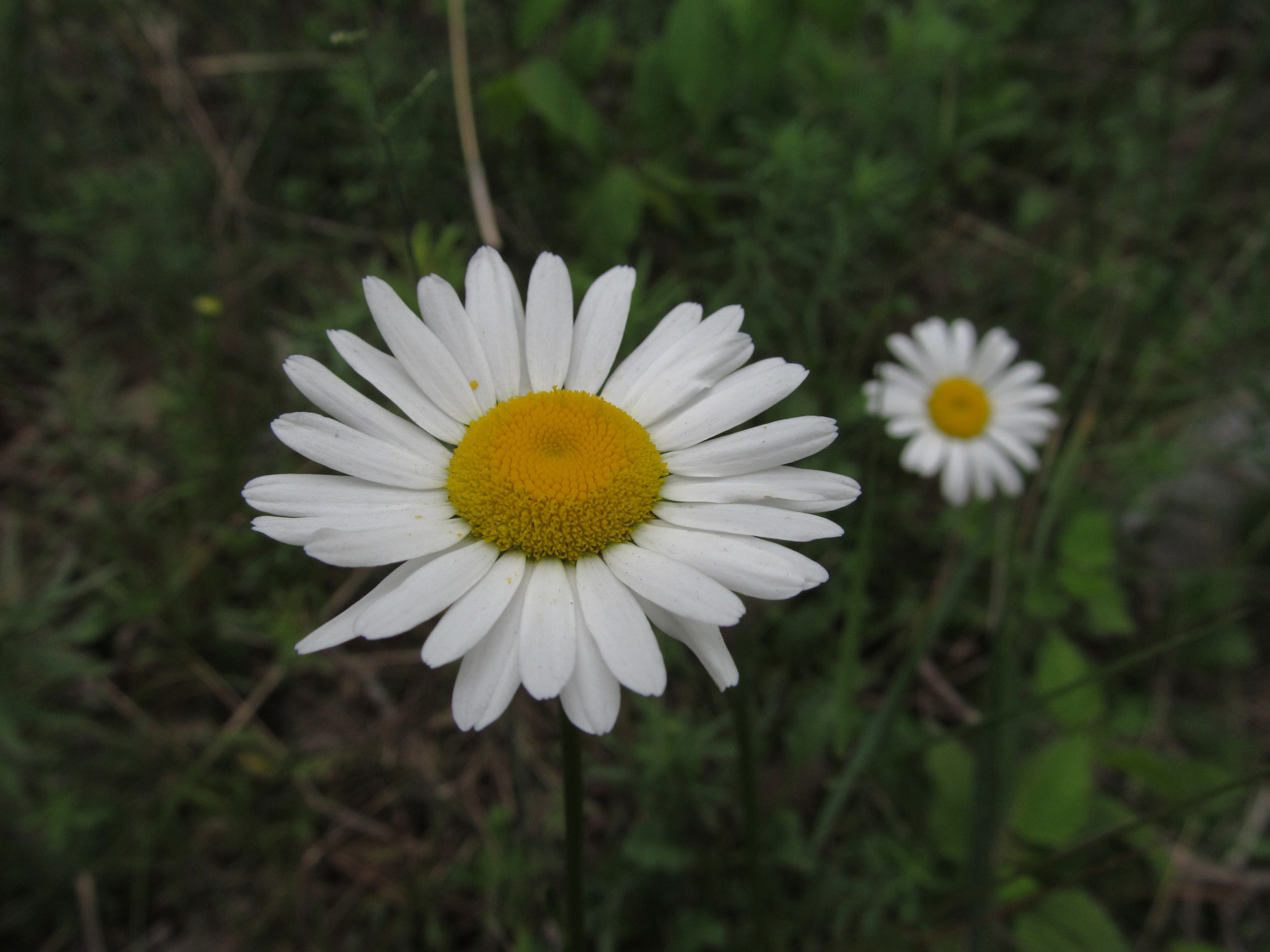
Daisies are sometimes weedy invaders, but it is almost impossible to hate them. They do sometimes form dense patches and crowd out native plants; but large patches like these are relatively infrequent, and they do not seem to pose a serious danger to our ecosystem.
There is no reason not to repeat what we said ten years ago:
This is the most universally beloved of all wild flowers, the focus of countless childhood traditions and the very image of “flower” in the popular imagination. It may be derided as a pernicious weed by agricultural and environmental authorities, but the ordinary citizen will never be persuaded to hate it.
Daisies like these were formerly kept in the genus Chrysanthemum, but have been removed by bored botanists to the genus Leucanthemum “because they are not aromatic and their leaves lack grayish-white hairs,” according to the Wikipedia article on the genus. (The genus “Leucanthemum” was apparently named by Lamarck, whose discredited theory of inheritance of acquired characteristics still haunts high-school biology classes.) Because of this new sorting of the genera, we leave Gray and give the description of the genus and species from the Flora of North America at efloras.org:
Perennials, (10–)40–130(–200+) cm (rhizomatous, roots usually red-tipped). Stems usually 1, erect, simple or branched, glabrous or hairy (hairs basifixed). Leaves mostly basal or basal and cauline; petiolate or sessile; blades obovate to lanceolate or linear, often 1[–2+]-pinnately lobed or toothed, ultimate margins dentate or entire, faces glabrous or sparsely hairy. Heads usually radiate, rarely discoid, borne singly or in 2s or 3s. Involucres hemispheric or broader, 12–35+ mm diam. Phyllaries persistent, 35–60+ in 3–4+ series, distinct, ovate or lance-ovate to oblanceolate, unequal, margins and apices (colorless or pale to dark brown) scarious (tips not notably dilated; abaxial faces glabrous or sparsely hairy). Receptacles convex, epaleate. Ray florets usually 13–34+, rarely 0, pistillate, fertile; corollas white (drying pinkish), laminae ovate to linear. Disc florets 120–200+, bisexual, fertile; corollas yellow, tubes ± cylindric (proximally swollen, becoming spongy in fruit), throats campanulate, lobes 5, deltate (without resin sacs). Cypselae ± columnar to obovoid, ribs ± 10, faces glabrous (pericarps with myxogenic cells on ribs and resin sacs between ribs; embryo sac development monosporic); pappi 0 (wall tissue of ray cypselae sometimes produced as coronas or auricles on some cypselae). x = 9.
Species 20–40+ (3 in the flora): introduced; mostly temperate Europe (some widely cultivated and sparingly adventive).
The three leucanthemums recognized here are weakly distinct and are sometimes included (with a dozen or more others) in a single, polymorphic Leucanthemum vulgare.
SELECTED REFERENCE
Vogt, R. 1991. Die Gattung Leucanthemum (Compositae–Anthemideae) auf der Iberischen Halbinsel. Ruizia 10: 1–261.
Chrysanthemum leucanthemum Linnaeus, Sp. Pl. 2: 888. 1753; C. leucanthemum var. pinnatifidum Lecoq & Lamotte
Perennials, 10–30(–100+) cm. Stems simple or distally branched. Basal leaves: petioles 10–30(–120) mm, expanding into obovate to spatulate blades 12–35(–50+) × 8–20(–30) mm, margins usually pinnately lobed (lobes 3–7+) and/or irregularly toothed. Cauline leaves petiolate or sessile; blades oblanceolate or spatulate to lanceolate or linear, 30–80+ × 2–15+ mm, margins of mid-stem leaves usually irregularly toothed proximally and distally.Involucres 12–20+ mm diam. Phyllaries (the larger) 2–3 mm wide. Ray florets usually 13–34+, rarely 0; laminae 12–20(–35+) mm. Ray cypselae 1.5–2.5 mm, apices usually coronate or auriculate. 2n = 18, 36, 54, 72, 90.
Some botanists (e.g., W. J. Cody 1996) have treated Leucanthemum ircutianum de Candolle, with blades of mid and distal cauline leaves oblong to oblong-lanceolate and not ± pinnate at bases, as distinct from L. vulgare.
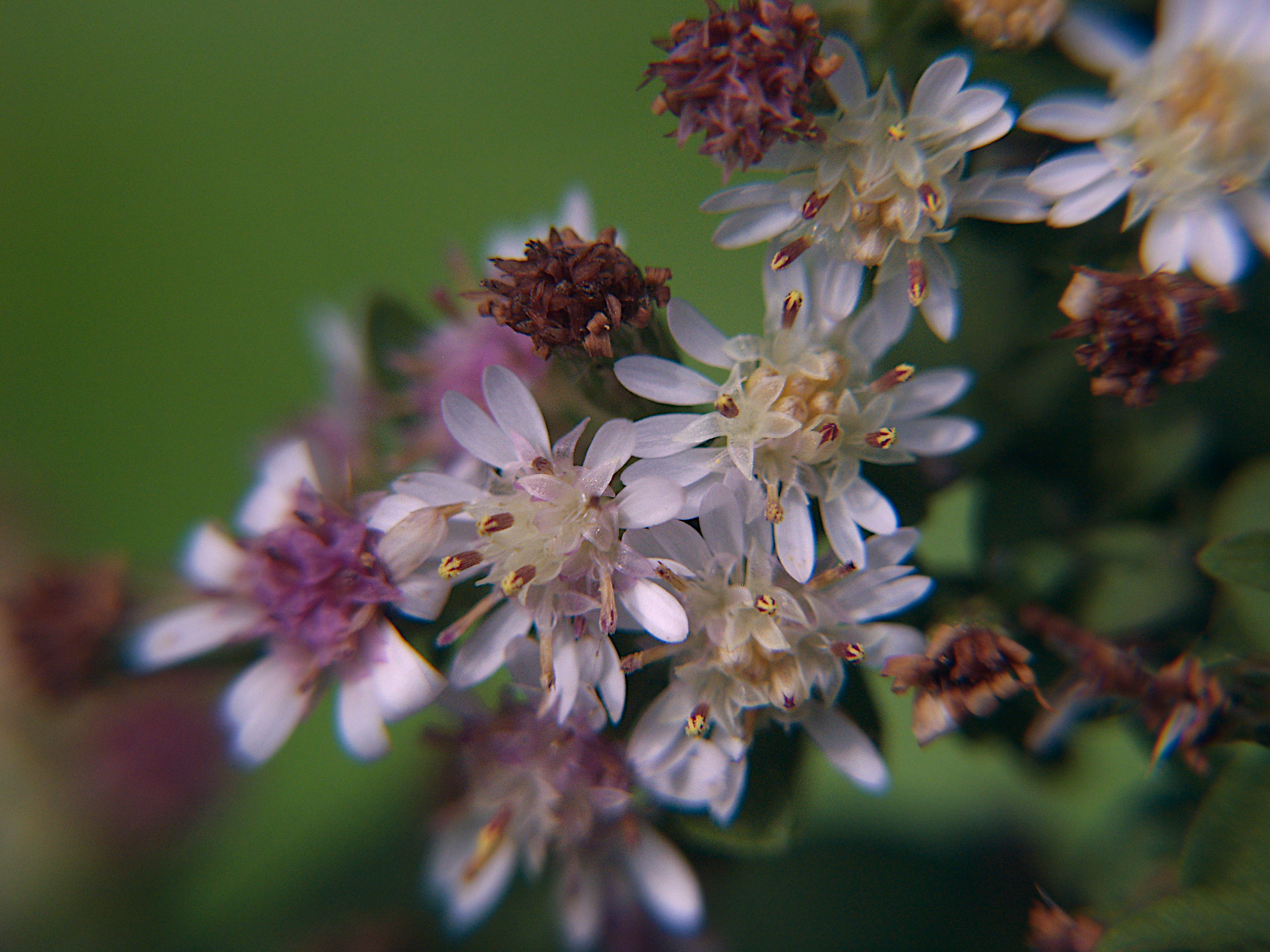
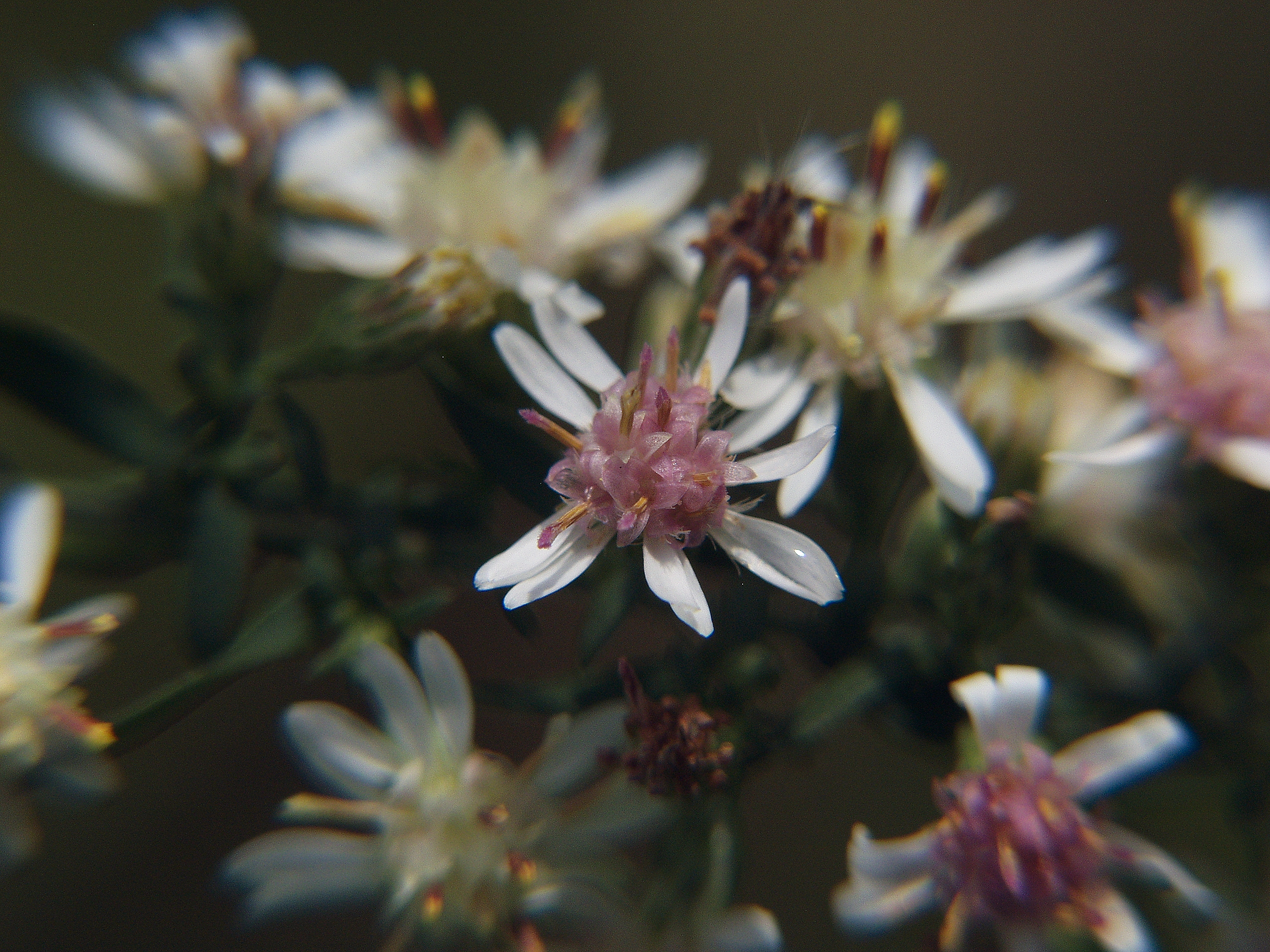
Formerly Aster latiflorus (-us instead of –um because Aster is masculine). These are the asters with tiny flower heads, often hundreds of them thickly covering the whole plant, that you see everywhere at the edges of lawns, in sidewalk cracks, and popping out from under hedges. Calico Asters (as we mentioned once before) are quite variable. “Consists of many races,” say Britton & Brown of this species, “differing in leaf-form, inflorescence and pubescence.” “Extensively variable,” says Gray. In other words, asters thumb their noses at the notion of a “species.” These are worth looking at with a magnifying glass: the disk flowers (the ones that make up the center of the flower head) look like little starfish, changing from pale translucent yellow through pink to deep rose. Flowers at all stages are on the plant at once, giving it the calico effect for which it is named.
The American members of the genus Aster have been moved to the genus Symphyotrichum, and we hope they like it there. This is our showiest Aster, and the pink form is fairly rare; Gray would make it var. roseus (which, in the neuter genus Symphyotrichum instead of the masculine Aster, would be var. roseum). We also have pictures of the usual purple form and the very rare white form.
Gray describes the genus Aster (where all North American species of Symphyotrichum lived until recently) and the species:
ASTER [Tourn.] L. STAR-WORT, FROST-FLOWER, ASTER. Heads many-flowered, radiate; the ray-flowers in a single series, fertile. Bracts of the involucre more or less imbricated, usually with herbaceous or leaf-like tips. Receptacle flat, alveolate. Achenes more or less flattened; pappus simple, of capillary bristles (double in 4 and 5). Perennial herbs (annual only in 7 and 8), with corymbed, panicled, or racemose heads, flowering chiefly in autumn. Rays white, purple, blue, or pink; the disk yellow, often changing to purple. Species often without sharply defined limits, freely hybridizing. (Name aster, a star, from the radiate heads of flowers.)
A. nòvae-ángliae L. Stem stout, hairy, 0.5-2.6 m. high, corymbed at the summit; leaves numerous, lanceolate, entire, acute, auriculate-clasping, 930. A. oblongifolius. clothed with minute pubescence, 0.5- 1 dm. long; bracts nearly equal, linear-awl-shaped, loose, glandular-viscid, as well as the branchlets; rays violet-purple, rarely white, very numerous; achenes hairy. Moist chiefly calcareous grounds, centr. Me. to w. Que., westw. and south w. Aug.-Oct. Heads large ; a very handsome species, popular in cultivation. (Escaped from gardens, and locally naturalized in Eu.) FIG. 931. Var. róseus (Desf.) DC. Rays pink or rose-color. Range of the typical form, local.
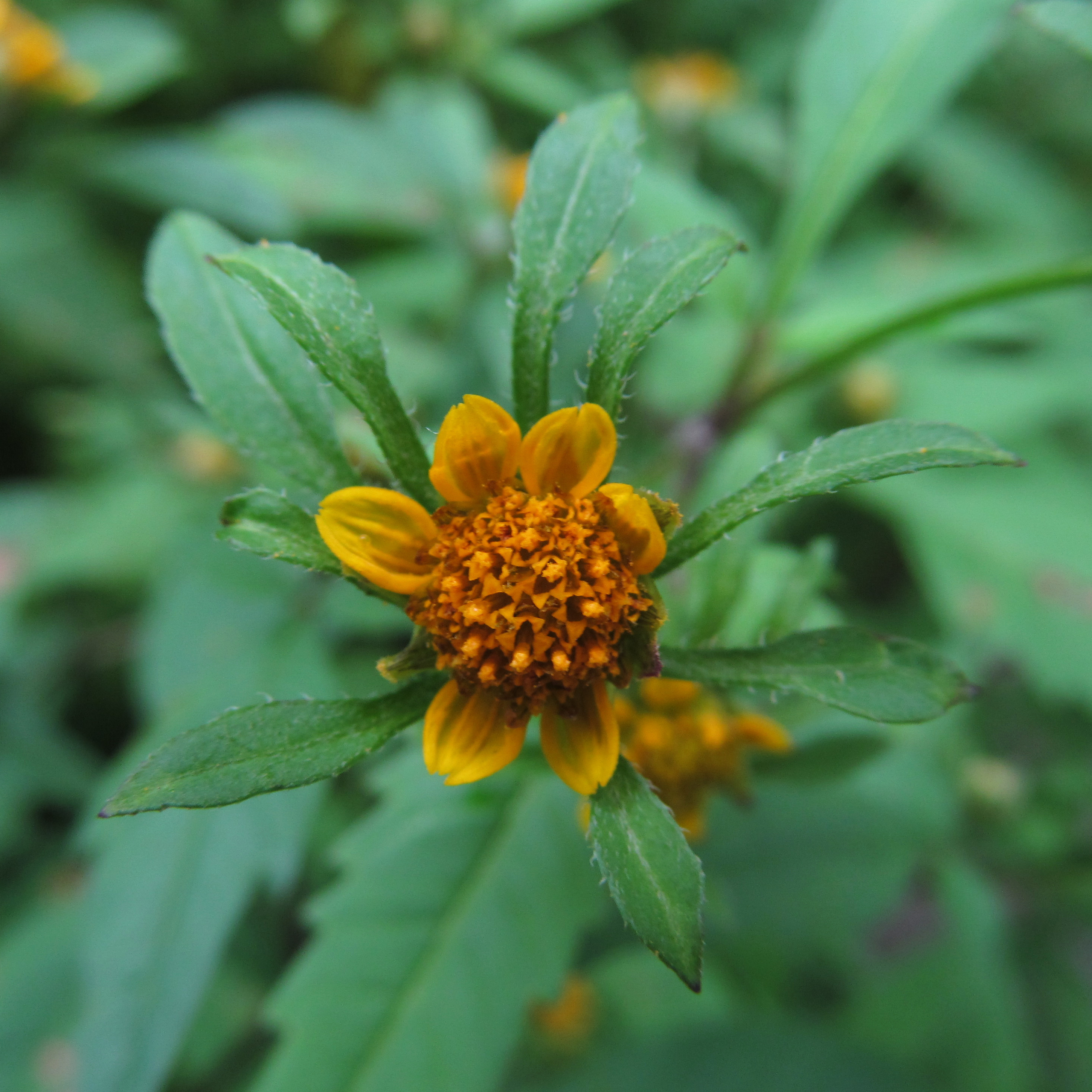
More often these plants have no rays on their flower heads, but forms with rays do occur, and this patch growing in Bird Park (Mount Lebanon) had unusually abundant rays on some flower heads (none on others). The “bur” in the name is the seed, which has a pair of little spikes that attach it to fur or clothing, spreading the plant very efficiently. It is distinguished from Spanish Needles (Bidens bipinnata) by larger flower heads with more florets, and by its leaves with three or five leaflets. The stems are often reddish.
Gray describes the genus and the species:
BÌDENS L. BUR MARIGOLD. Heads many-flowered; the rays when present 3-8, neutral. Involucre double, the outer commonly large and foliaceous. Receptacle flattish; chaff deciduous with the fruit. Achenes flattened parallel to the bracts of the involucre, or slender and 4-sided (rarely terete), crowned with awns or short teeth (these rarely naked). — Annual or perennial herbs, with opposite various leaves, and mostly yellow flowers. (Latin, bidens, two-toothed.)
N. B. — In this genus the measurements of the fruit relate to the inner mature achenes. The outer are often shorter and uncharacteristic.
B. frondòsa L. (BEGGAR-TICKS.) Stems tall (7 dm. or less in height), paniculate-branched; leaves 3–5-divided, glabrous, the terminal leaflet long-stalked, acuminate, often again divided, lateral ones shorter, less acuminate, all sharply serrate; heads 1.5 cm. long or less, on slender peduncles; outer involucre of 5–8 ciliate bracts; rays small, yellow; achenes narrowly cuneate, 7-10 mm. long, black, strongly 1-nerved on each face, often slightly hairy, the retrorsely barbed slightly divergent slender awns barely half as long, exceeding the 5-toothed orange corolla. (B. melanocarpa Wiegand.) — Common in damp ground, throughout. Aug., Sept. Fig. 994. Var. ANOMALA Porter. Awns upwardly barbed. — Local, N. S. to Pa.