Author: Father Pitt

  • Golden Ragwort (Senecio aureus)

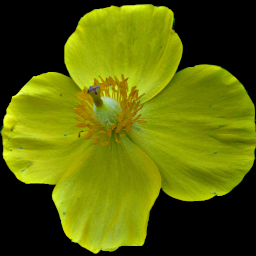
    Senecio-aureus-2013-05-05-Scott-01Golden Ragworts are attractive flowers, a bit like a yellow aster, that bloom in the middle spring, just after the tulips in your garden. The heart-shaped basal leaves and the pinnately lobed (rather fern-like) stem leaves are distinctive. They like a somewhat shady location; these were blooming in early May near a stream in Scott Township.

    Gray (with help from J. M. Greenman) describes the genus and the species:

    SENECIO [Tourn.] L. GROUNDSEL. RAGWORT. SQUAW-WEED. Revised By J. M. Greenman. Heads many-flowered; rays pistillate or none; involucre cylindrical to bell-shaped, simple or with a few bractlets at the base, the bracts erect-connivent. Receptacle flat, naked. Pappus of numerous very soft and capillary bristles.— Ours herbs, with alternate leaves and solitary or eorymbed heads. Flowers chiefly yellow. (Name from senex, an old man, alluding to the hoariness of many species, or to the white hairs of the pappus.)

    S. aureus L. (GOLDEN R. ) Stems erect from rather slender rootstocks, 3-8 dm. high, at first often lightly floccose-tomentose, soon glabrate; lower leaves long-petioled, ovate-rotund to slightly oblong, 1.5-8 cm. long, two thirds as broad, crenate-dentate; stem-leaves lyrate to laciniate-pinnatifid; the uppermost sessile, amplexicaul, often bract-like; inflorescence cymose-corymbose; heads radiate; rays yellow; achenes glabrous. — In wet meadows, moist thickets, and swamps, Nfd., s. to Va., w. to Wisc., Mo., and Ark. May-Aug.
  • Miterwort (Mitella diphylla)

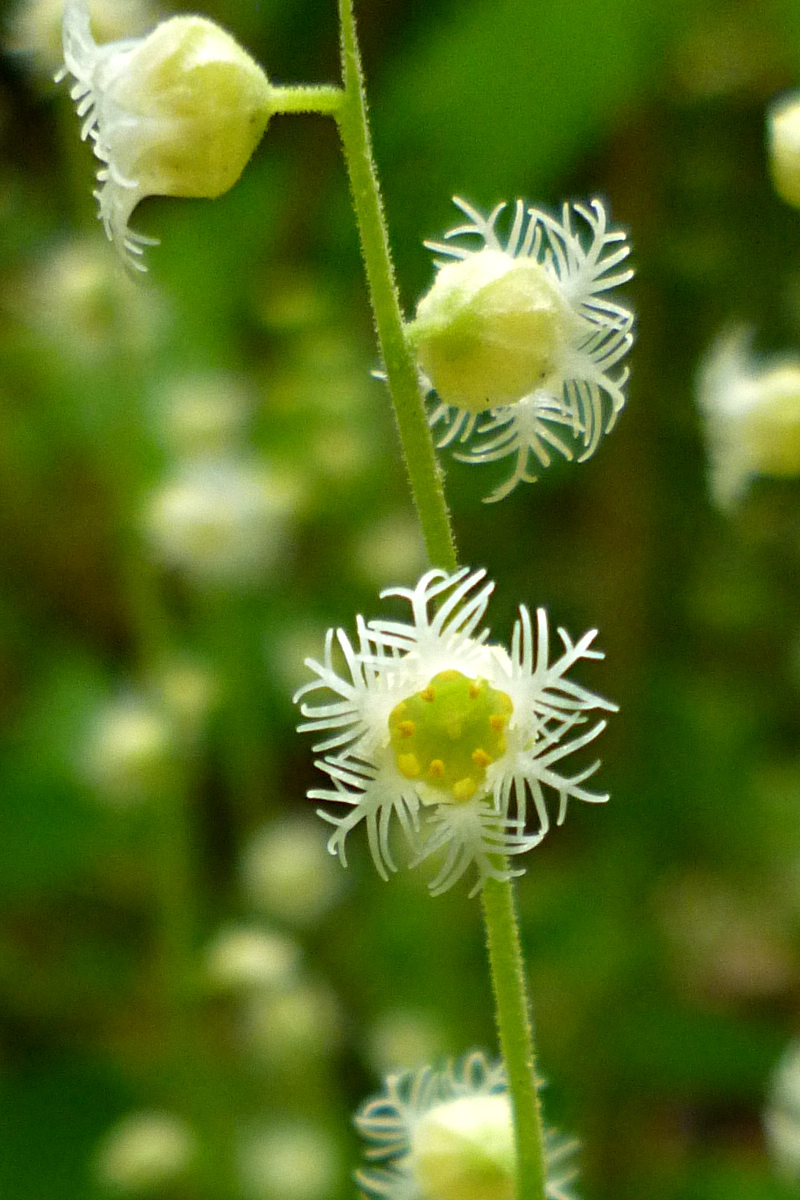
    Mitella-diphylla-2013-05-08-Fox-Chapel-02A very close view of the delicately fringed flowers. This plant grew in the Squaw Run valley, where it was blooming in early May. A general view of the entire plant is here.

    Gray describes the genus and the species:

    MITELLA [Tourn.] L. MITERWORT, BISHOP’S CAP. Calyx short, adherent to the base of the ovary, 6-cleft. Petals 5, slender. Stamens 5 or 10, included. Styles 2, very short. Capsule short, 2-beaked, 1-celled, with 2 parietal or rather basal several-seeded placentae, 2-valved at the summit. Seeds smooth and shining. Low and slender perennials, with round heart-shaped alternate slender-petioled leaves on the rootstock or runners, and naked or 2-few-leaved flowering steins. Flowers small, in a simple slender raceme or spike. Fruit soon widely dehiscent. (Diminutive of mitra, a cap, alluding to the form of the young pod.)

    M. diphylla L. Hairy; leaves heart-shaped, acute, somewhat 3-5-lobed, toothed, those on the many-flowered stem 2, opposite, nearly sessile, with interfoliar stipules; flowers white, in a raceme (1.5-2 dm. long); stamens 10. Rich woods, Que. and N. E. to N. C., w. to Minn., Ia., and Mo. May.

  • Wake-Robin, Pink Form (Trillium erectum)

    Trillium-erectum-pink-2013-05-01-Fox-Chapel-01The ordinary color of this flower is deep mahogany red, but in the Squaw Run valley the flowers are almost always white. Occasionally a pink one shows up, as this one did, which was blooming at the beginning of May.

    The odor  is described in the Flora of North America as “like a wet dog,” which is unmistakable, and accounts for another common name, Stinking Willie. It’s not a flower to sniff with delight.

    Gray describes the genus and the species:

    TRÍLLIUM L. WAKE ROBIN. BIRTHROOT. Sepals 3, lanceolate, spreading, herbaceous, persistent. Petals 3, larger, withering in age. Stamens б; anthers linear, on short filaments, adnate. Styles awl-shaped or slender, spreading or recurved above, persistent, stigmatic down the inner side. Seeds ovate, horizontal, several in each cell. — Low perennial herbs, with a stout and simple stem rising from a short and praemorse tuber-like rootstock, bearing at the summit a whorl of 3 ample, commonly broadly ovate, more or less ribbed but netted-veined leaves, and a terminal large flower; in spring. (Name from tree, three; all the parts being in threes.) — Monstrosities are not rare with the calyx and sometimes petals changed to leaves, or the parts of the flower increased in number.

    Ovary and fruit 6-angled and more or less winged.

    Flower pediceled; connective narrow, not produced; leaves subsessile.

    Anthers at anthesis exceeding the stigmas.

    T. eréctum L. Leaves very broadly rhombic, shortly acuminate; peduncle (2—8 cm. long) usually more or less inclined or declínate; petals ovate to lanceolate (18-36 mm. long), brown-purple or often white or greenish or pinkish; stamens exceeding the stout distinct spreading or recurved stigmas; ovary purple; fruit ovoid, 2.5 cm. long, reddish. — Rich woods, e. Que. to Ont., southw. to Pa. and in the mts, to N. C. — Flowers ill-scented.

  • Striped Cream Violet (Viola striata)

    Viola-striata-2013-05-01-Fox-Chapel-02

    Misidentifying violets is easy; we have done it here more than once. There are several similar white violets in our area, but this species should be easy to identify if we look for a combination of three things: bearded side petals (see the enlargement above), leafy flower stems  (in some other species the flowers rise directly from the base with no leaves on the flower stems), and roundish toothed leaves (see the picture below; the leaves of Canada Violet, for example, are more elongated).

    Viola-striata-2013-05-01-Fox-Chapel-01

    Gray (with help from his successors) describes the genus and the species:

    VtOLA [Tourn.] L. VIOLET. HEART’S-EASE. Revised By E. Brainerd. Petals somewhat unequal, the lower one spurred at the base. Stamens closely surrounding the ovary, often slightly cohering with each other; the two lower bearing spurs which project into the spur of the corolla. Besides these conspicuous blossoms, which appear in spring, others are produced later, on shorter peduncles or on runners, often concealed under the leaves; these never open nor develop petals, but are fertilized in the bud and are far more fruitful than the ordinary blossoms. —The closely allied species of the same section, when growing together, often hybridize with each other, producing forms that are confusing to the student not familiar with the specific types. The hybrids commonly display characters more or less intermediate between those of the parents, and show marked vegetative vigor but greatly impaired fertility. (The ancient Latin name of the genus.)

    Plants with leafy stems.

    Style not capitate, slender; length of spur at least twice its width; stipules fringed-toothed, somewhat herbaceous.

    Tip of the style bent downward, slightly pubescent near the summit; lateral petals bearded; spur less than 8 mm long.

    Petals white or cream-colored.

    V. striata Ait. Usually 16-30 cm. high when in flower, often in late summer 6 dm. high, glabrous or nearly so; leaves heart-shaped, finely crenate-serrate, often acute; stipules large, oblong-lanceolate; spur rather thick, shorter than the petals; sepals ciliate, narrow, attenuate; capsules ovoid, glabrous, 4-6 mm. long; seeds light brown. — Low or shady ground, Ct. to Minn., and southw.

  • Siberian Bugloss (Brunnera macrophylla)

    Brunnera-macrophylla-2013-05-03-Bird-Park-01Flora Pittsburghensis makes an important original contribution to the botanical literature. Brunnera macrophylla is recorded as naturalized in Ohio and New York, but not in Pennsylvania. We have found it, however, deep in the woods in Bird Park in Mount Lebanon, some distance from any cultivated planting.

    Siberian Bugloss looks very much like a species of Forget-Me-Not (Myosotis spp.), but is easily distinguished by its large heart-shaped leaves (thus the specific name macrophylla, which means “large-leaved”). These plants grew in Bird Park in Mount Lebanon, where they were blooming at the beginning of May.

    Gray does not describe this species, but the quick description above should make identification straightforward.